
Can a cow be musical, a hen good at maths and a pig a lover of cleanliness? Why do we keep repeating sayings that portray animals in a hurtful and untrue way? And what would the world be like if we could really understand what animals are trying to tell us?
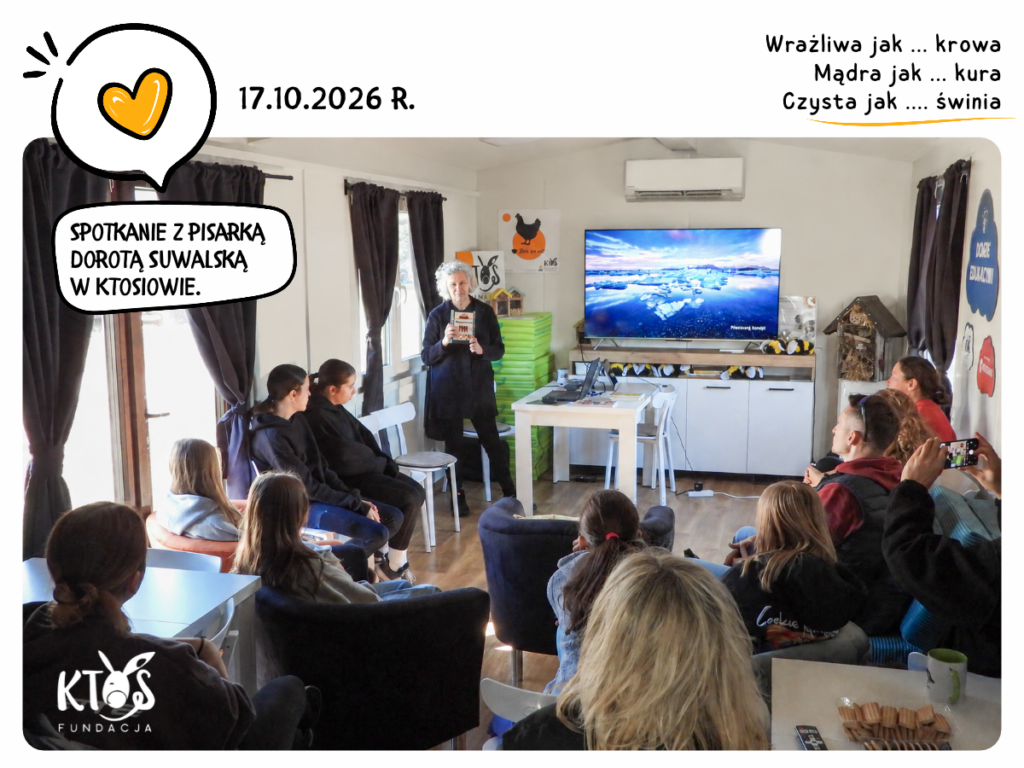
We talked about all of this at a special literary meeting with Dorota Suwalska, held on 17 October at the KTOSIOWO sanctuary.
Our guest was a writer, illustrator and cultural educator, the author of books for children and young people, including “Znowu kręcisz, Zuźka!”, “Bruno i siostry”, “Marionetki Baby-Jagi” and “Czarne jeziora”. Dorota Suwalska has twice been nominated for the prestigious Astrid Lindgren Memorial Award.
She is currently working on a science fiction novel for children, “Świnie, krowy, kury – 2060” (Pigs, Cows, Hens – 2060), written with a City of Warsaw Artistic Scholarship for 2026.
Dotka, who wasn’t ready for the world yet
One of the heroines of the new book is Dotka – a chick we meet before she hatches, while she is still inside her egg.
Dotka can hear the voices of other chicks. They are discussing whether they are ready to leave their shells and see the world. But Dotka isn’t ready yet…
When she finally hatches, she meets her mum, brothers and sisters. She also notices mysterious “Non-hens”, whose bald faces make her enormously curious.
It is a fascinating change of perspective. This time it is not a human watching animals, but an animal watching a human. What is ordinary to us turns out to be something completely new and astonishing to little Dotka.
And did you know that chicks really do communicate before they hatch? Research confirms that chicks developing in their eggs make sounds to which their mother also responds.
So Dotka reminds us that the animal world is full of relationships and messages we usually fail to notice.
At the meeting we also met Prążek – a young bull, another animal hero of the story, who lets us look at reality from the perspective of a completely different species.
Sensitive as a… cow!
One of the most interesting parts of the meeting was a game of making up new sayings.
Dorota Suwalska encouraged the children to finish the sentences:
As sensitive as…
As musical as…
As caring as…
The answer? A cow!
Why a cow?
Cows are social animals, able to form strong and lasting bonds. Mothers care tenderly for their calves, and separating animals that are close can cause stress. Researchers are also studying how cows react to music, including classical music, and how it might affect their well-being.
So instead of reinforcing stereotypes, we can say:
“As close as two cows.”
And suddenly an animal that our language so often reduces to its usefulness becomes a symbol of closeness, sensitivity and friendship.
Dirty as a pig? Nothing could be further from the truth!
And now a riddle:
She loves cleanliness, has an excellent sense of smell, cares for her children and can even learn to use a computer. Who is she?
A pig!
At the meeting we learnt how unfair the popular Polish saying “dirty as a pig” really is.
Pigs keep their surroundings clean as long as they are given the right conditions. Contrary to stereotypes, they do not choose dirt for its own sake.
They are also intelligent, curious and able to learn complex tasks. Scientific studies have even shown that they can learn to do a computer task using a joystick.
Literary visions of animals naming their children prompt further questions about their relationships and communication. We already know that pigs recognise their offspring, communicate vocally and form social bonds.
And yet in our language we so often use their name to insult someone.
Dorota Suwalska shows that it is worth looking closely at the words we use. Because language does not just reflect our ideas about animals — it also reinforces them.
Hens that can count
Hens can be surprising too.
At the meeting we talked about their cognitive abilities, memory and communication skills.
Research shows that even very young chicks can tell the difference between quantities and even perform simple tasks resembling addition and subtraction.
Hens also recognise familiar individuals, communicate with a range of signals and build social relationships.
It is a far more complex world than the stereotypical image of a hen suggests.
The year 2060 – a future that could be different
Dorota Suwalska’s novel is set in a future in which animals are no longer treated as part of the food production system.
Pigs, cows and hens live in a world where they have their own place in the ecosystem. They form communities, build relationships, take part in the life of their environment and coexist with other species.
It is a vision of a future in which humans do not exploit animals, but learn to live alongside them, respecting their needs and natural behaviour.
One of the fascinating elements of this world are translators of animal communication that help different species understand each other better.
Sounds like science fiction?
Of course. But not all of it is pure fantasy.
Scientists are already analysing animal sounds, their meaning and their links with behaviour and emotional states. They use artificial intelligence to help recognise particular patterns of communication.
This does not yet mean we can literally translate animal conversations into human language. But it shows how much there is still to discover and how fast our knowledge of other species is growing.
A book that changes perspective
Although “Świnie, krowy, kury – 2060” is a science fiction novel, its message is about our present.
It is a story that challenges stereotypes, reveals animals’ cognitive, emotional and social abilities to the reader and encourages us to question the traditional way we see them.
What is especially important is that the characters are not portrayed through the lens of their usefulness to humans.
They are individuals. They have their own experiences, needs, relationships and their own place in the world.
Interestingly, while working on the book, Dorota Suwalska had already visited the KTOSIOWO sanctuary, gathering material and getting to know the animals that may inspire her characters. As she described it herself, being able to watch animals that live without being destined for production was an important experience for her.
And that is exactly why this meeting meant so much to us.
At KTOSIOWO, every day we get to know animals as individuals, not as members of a species assigned to a particular role or function.
Each has their own character, needs, history and relationships with others.
Literature can help us see what we did not notice before. It can also encourage us to change the words we use to describe the world.
Because before we change how we treat animals, sometimes we have to change how we think about them.
Thank you to Dorota Suwalska for a truly inspiring meeting, and to the children and their carers for a shared journey into a world where animals are the rightful heroes of their own stories.
Every animal can be a hero. Not only in a book. Because every animal is Somebody, not something.